The Arrival and Settlement of Macedonians in the Inner Western Suburbs
of Melbourne
By Nick Anastasovski
Printable
Version
Abstract
Macedonians from under Yugoslav rule did not arrive in Victoria in large
numbers until the 1970s. Many chose Melbourne’s inner western suburbs
as their new home; here they found abundant employment opportunities
and cheap suburban accommodation. Within a decade, Macedonians would
come to form an integral part of the ‘inner west’. This article
identifies the longer history of Macedonians’ migration to Australia
and then examines this post-war migrant study’ in this light, focussing
on the suburbs and industries in which Macedonians lived and worked
and quickly became identified. It traces their considerable (and continuing)
efforts to preserve their ethnic roots—by forming Macedonian associations
and establishing institutions. Drawing largely on recent interviews
with several migrants and using illustrative evidence from family and
community photographs to enlarge on the human story, this study seeks
to give new recognition to a people who had struggled under several
regimes. It proposes to deepen our knowledge of the diverse backgrounds
Melbourne’s post-war ‘new’ migrants and, finally, it
tells one nation’s story of will and economic and cultural survival—once
here.
It is estimated that there are between two and three million Macedonians
in the diaspora. Outside of the Balkans, the main communities are in
Western Europe, the United States, Canada and Australia. During the
20th century, Macedonians arrived in Australia in a series of waves.
They settled predominantly in Perth, Sydney, Newcastle, Wollongong and
Melbourne. Until the 1940s, most of Australia’s Macedonian migrants
had lived under Greek rule. This work specifically examines the later
cohort who arrived in Victoria after the Second World War following
the formation of the Republic of Macedonia (1944), one of six new republics
of the Socialist Federative Republic of Yugoslavia (SFRY) led by Josip
Tito (1892–1980). Macedonians, mainly from rural regions, began
migrating in the 1950s and 1960s, and their numbers rose considerably
in the 1970s, once the Tito government’s restrictions had been
appreciably eased. A large number settled in the ‘inner western’
suburbs of Melbourne and have left their imprint. For the purposes of
this study, the inner west of Melbourne is defined as the suburbs of
Footscray, Seddon, Yarraville, Spotswood, Newport and Williamstown.
Documenting Melbourne’s Macedonians
The aim of this study is to document the neglected history of the circumstances,
arrival and formative years of the Macedonian community in the western
suburbs of Melbourne since the late 1950s. This work traces where Macedonians
lived and worked and examines how they sought to preserve and promote
their cultural heritage, particularly in light of their country’s
fragmented political history. It discusses the manner and dedication
with which Macedonians celebrated spiritual, social and recreational
activities, describing the formation of cafés and sporting clubs,
and the establishment of the first Macedonian Orthodox Church in the
western suburbs. In their commitment to creating their own organisations
and continuing cultural and religious practices—in effect re-establishing
their own traditions after a history of subjugation—Macedonians
were radically changing the landscape of the inner west.
Although Macedonians formed one of the largest ethnic groups of southern
Europeans in Melbourne (and Australia) in the 1970s, there are limited
written resources to draw upon. This article relies primarily on oral
histories, which proved to be a rich source of personal and social material.
In all, 12 individuals were interviewed, including Wally Curran, former
secretary of the Australasian Meat Industry Employees Union (Victoria).
Apart from Curran, the remaining 11 interviewees were of Macedonian
background: 9 were male, aged between approximately 50 and 70 years
old. The majority arrived in Australia in the early 1970s, and 3 came
here in the 1960s. Only 2 females participated in this study.1

Background: Pechalba and Pechalbari
For centuries, Macedonians travelled abroad in search of employment.
They were mostly young men who would work for several years or more
before returning home with the intention of building a larger family
home and purchasing more land. This tradition of migratory labour is
known as pechalba. In the late 19th century, the practice of pechalba
increased because of unstable conditions under Ottoman Turkish rule,
to be followed by temporary suspension during the Balkan Wars of 1912–1913,
and then came Macedonia’s partition by her neighbours Greece, Serbia
and Bulgaria in 1913, with Albania acquiring a piece of Macedonian territory
in 1920. Once divided into several geo-political entities, Macedonians
were forced to endure new assimilatory policies. Overwhelmingly, those
seeking work abroad as migrant labourers in the 1920s came from Greek
and Serbian territories, with far more limited numbers from Bulgarian
and Albanian areas.
Pechalbari in Australia Since the 1880s
Peter Hill, in his 1989 book, The Macedonians in Australia, tells stories
and traces the circumstances of the first arrivals. Reportedly, those
who came to Australia in the latter part of the 19th century and the
early 20th century were following news of the discovery of gold. They
chose places such as Kalgoorlie in Western Australia, or Broken Hill
in New South Wales.2 Amongst the early arrivals were men from the Kostur
and Lerin regions (under Greek rule) and the Bitola region (under Serb
rule).3 The United States was the most popular destination for pechalbari
from the 1890s until it imposed severe restrictions on certain categories
of immigrants in 1924. Many then turned their eyes to Australia, a new
and distant destination. Macedonian arrivals in Australia after 1924,
and up to the 1960s, were overwhelmingly from under Greek rule, the
remainder were from villages in the territory under Serbian–Yugoslav
domination.
Many of these early Macedonian migrants worked in Western Australia
and, in the tradition of pechalba, did not see themselves as permanent
settlers. They were typically bush workers moving around in small groups
of three or four men and clearing virgin bushland in remote areas for
future farms. Often they remained isolated for months at a time. Working
long hours from sunrise to sunset, pechalbari followed the road to where
there was work, a search that took them scrub-clearing in Ceduna and
Sugena on the west coast of South Australia; cutting railway sleepers
in Grafton, New South Wales, or in Bridgetown and Manjimup in Western
Australia; grape picking in the Riverland of South Australia; and cutting
sugar cane in Queensland.4 Jan Harper has written of Macedonians in
rural Victoria in her 2004 article, ‘The Pecalbars of Gippsland:
Macedonian Farmworkers around Kernot in the 1930s’. Her study gives
further insight into these small communities of Macedonian migrants
who lived and worked around the towns of Kernot, Glen Forbes, Glen Alvie,
Krowera, Jeetho West and Korumburra.5 Here, they engaged in hard manual
work clearing South Gippsland’s bushland several decades before
their post–Second World War Macedonian compatriots came to Victoria’s
urban regions (apart from a small group who had settled in Melbourne
earlier), beginning in the 1950s and increasing to mass proportions
in the 1970s.
Melbourne’s First Macedonians
Melbourne’s first Macedonian community emerged during the 1920s
and 1930s in the then inner working-class suburb of Fitzroy. Their numbers
grew because of ongoing discriminatory policies of the Greek government.
By the 1950s, a flourishing Macedonian community was seen around Gertrude
Street, Fitzroy; the Fitzroy community would later spread into the neighbouring
suburbs of Collingwood and Clifton Hill, and, by the late 1960s and
1970s, the Melbourne diaspora had extended further north to Northcote,
Thornbury and Preston.
Prior to 1960, only a small number of Macedonians were living in the
inner west.6 They had escaped illegally from Yugoslavia at the end of
the Second World War and for some time after.7 Typically, they came
from traditional pechalbar villages, such as Brusnik, Bukovo, Velushina
and Graeshnica in the Bitola region upper villages along the Baba Mountains
ranges.
The Prespa region’s village of Brajchino was renowned for sending
its young men abroad on pechalba, a practice dating back to the second
half of the 19th century. Giorgi Kalcovski followed this tradition when
he left Brajchino village by illegally crossing the Yugoslav–Greek
border, and, after spending time in a Greek refugee camp, he arrived
in Australia in 1958. Kalcovski soon moved to Moore Street, Footscray,
where he shared a house with four other recently arrived single men
from the Bitola region upper villages. He worked at Kinnears Ropes in
Ballarat Road, Footscray, with other men from the Bitola region.8 Here
is an early example of a nucleus of a Macedonian inner west community,
albeit confined to young men residing at just one house.
It was not until the early 1960s that Yugoslavia’s communist
regime commenced relaxing travelling restrictions; however, the bureaucracy
was complicated and passports were notoriously difficult to obtain from
the interior ministry. Macedonians who were employed in state enterprises
could not leave the country until they obtained approval from their
employer. Those who managed to leave typically did so in the tradition
of pechalba, and they were single young men who generally intended to
work abroad for a few years before returning home. Indeed, these young
men working in Melbourne’s inner west found factory work vastly
different from their rural village employment experiences. Some returned
to Macedonia after a few years with savings that enabled them to build
new homes, purchase more land, or set up small-scale businesses, but
most remained in Australia.

Tose Spasevski arriving at Port Melbourne in 1964. Photograph courtesy
of Bob Spasevski.
One man who stayed was Mihailo Kleshtev. He arrived in 1964, initially
planning to work in Melbourne for a few years then return to his family.
He soon saw that there were greater prospects in Australia. In early
1966, Mihailo brought out his wife and two young children and they were
one of the first Macedonian families to settle in Williamstown.9
1970s and New Arrivals
In 1970, the remaining restrictions on emigration were removed, and
young men in traditional pechalbar regions such as Ohrid, Prilep, and
particularly Bitola (where the author’s family had lived), ommenced
leaving on a large scale. As Macedonia was the southernmost republic
of Yugoslavia, the long journey to Australia involved travelling by
train across the entire length of Yugoslavia, through Serbia, Bosnia,
Croatia and Slovenia, before reaching the Italian border. Genoa was
the key port in Italy from which Macedonians boarded ships for the 30-day
voyage to Australia. In the 1960s and 1970s, ships such as Galileo Galilei,
its sister ship, Guglielmo Marconi, and others left on a monthly basis
for Australia, docking at Fremantle, Adelaide, Melbourne and Sydney.

Ship docking at Port Melbourne 1968. Photograph courtesy of Mihailo
Kleshtev.
With the easing and then elimination of travel restrictions in the
1960s and 1970s respectively, Macedonian emigration grew slowly at first,
then massively during the latter decade. The experience for many was
profound. For example, in the Bitola region virtually no family was
left untouched by its scale and sweep; and notably, a large number from
Bitola’s rural villages came to Australia. One interviewee, Zivko
Vasilevski, witnessed the constant stream of fellow Macedonians arriving
by ship at Port Melbourne in the early to mid-1970s as he and others
waited at the dock when ships were due. Among the new arrivals, they
would invariably find friends, relatives or acquaintances from their
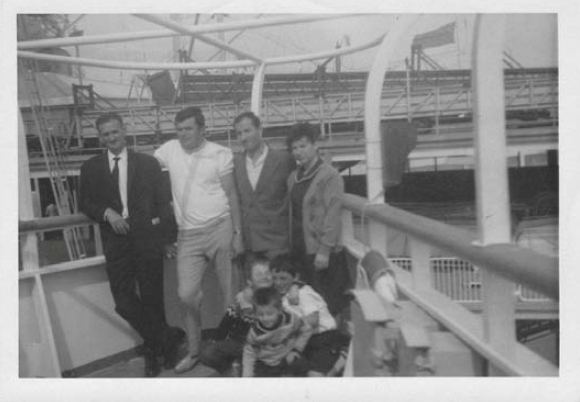
villages or region.10 The photograph of the Kleshtev family below evokes
something of this experience a little earlier in 1968.
Large Image

Kleshtev family awaiting new arrivals at Port Melbourne, 1968. Photograph
courtesy of Mihailo Kleshtev.
Newcomers were greeted at Port Melbourne by their sponsors, who were
usually relatives. Accommodation was also provided by the sponsor for
several months or more, and employment was pre-arranged to commence
within days of arrival. The Melbourne working-class suburbs of the inner
north and inner west were the principal destinations during the late
1960s and 1970s; other Macedonians resided in Richmond, Springvale and
Dandenong.
Living and Working in the Inner West
The inner western suburbs were attractive to newly arrived Macedonians
owing to the availability of inexpensive accommodation and an abundance
of employment opportunities. A concentration of industry had been a
dominant feature of the western suburbs dating back to the 19th century.
However, in the economically charged 1960s, Australia needed to increase
its urban population. Macedonians quickly found work and wrote letters
home to family and friends encouraging them to migrate to Melbourne.
It was a relatively simple process to sponsor others to Australia at
the time, and numbers rapidly increased to the point when, in the mid-1970s,
a firmly established Macedonian community was spreading across Yarraville,
Footscray and Seddon, and also in the outer inner west suburbs of Spotswood,
Newport and Williamstown. The highest concentration was in Yarraville
because of the proximity to industries and the pull of chain migration.

Spase Najdovski with friend in Slivica village preparing to leave
for Australia, 1969. Photograph courtesy of the Najdovski family.
Some of the larger employers of Macedonian immigrants included: Kinnears
Rope Works in Ballarat Road, Footscray; Olympic Tyre and Rubber in Cross
Street, West Footscray; Pelaco in Duke Street, Braybrook; Australian
Bobbins in Graingers Road, West Footscray; Invicta (later Pacific Carpets)
in Paramount Road, Tottenham; Olex Cables in Sunshine Road, Tottenham;
ACI Glass in Hudsons Road, Spotswood; and Port Phillip Wool Mill in
Nelson Place, Williamstown.
Macedonians were particularly prevalent in the metal, rubber, textile
and meatworks industries. They were prepared to work hard, for low rates
of pay, under tough conditions, which were often dirty and at times
unsafe. As well, they were opportunistic young men who often sought
new employment opportunities with higher paying employers. In 1964,
Mihailo Kleshtev commenced work at Port Phillip Wool Mill, in Nelson
Place, Williamstown, where he earned $30.00 per week. He remained there
for three months before moving to the James Hardie Company, in Hardie
Road, Brooklyn, where he worked on a rotating shift basis for an increased
weekly wage of $43.00.11

Spase Najdovski at work in Invicta Carpets, Tottenham, in the early
1970s. Photograph courtesy of the Najdovski family.
There were three principal factories in the Yarraville/Footscray area
involved in textile manufacturing—Davis Coop, in Francis Street,
Yarraville, Bradmill Cottonmills, in Moreland Street, Yarraville (before
moving to Francis Street, Yarraville), and Dickies Towels, in Hyde Street,
Yarraville.

Bradmill Cottonmills, Francis Street, Yarraville. Photograph Nick
Anastasovski.
A stable workforce of approximately 300 Macedonian men and women worked
in these three factories in the mid-1970s, and many more worked for
short periods before moving on to other industries that paid better.
However, the single most defining industry for the Macedonians of Melbourne’s
inner west during the 1970s and 1980s was the local meatworks.
The Meatworks—‘smells, blood and guts’
After arriving in Melbourne in 1969, Slavko Talevski spent more than
two decades working in the textile industry at Bradmill Cottonmills
and Davis Coop. He recalls many Macedonians moving from textiles to
the meatworks industry.12 The western suburbs have had a long association
with abattoirs dating back to the mid- to late 19th century.13 The arrival
of a large number of Macedonians in the 1960s and 1970s saw one of the
most recent migrant groups from southern Europe becoming closely identified
with the inner west’s major meatworks.
Most of the Macedonians had come to Australia from rural villages,
where all households maintained livestock, including cows, sheep, pigs
and chickens, essential for the family’s sustenance. Meat in the
villagers’ diet came from family farm animals, which were slaughtered
by male members of the household (women would slaughter chickens). So
Macedonians were used to slaughtering farm animals and were also familiar
with the labouring processes of meat preparation and preservation. These
skills equipped them well to work in the abattoirs and meat industry
in their new environment. The men were used in the meatworks as slaughtermen,
boners and butchers. Employment in the industry was not exclusively
male, as Macedonian women also had jobs there as meat cleaners and packers.
It was hard, physical work, but these young men and women were attracted
to the industry’s high wages. In this setting, thousands of cattle
and sheep were slaughtered daily. The carcasses would be rotated through
the plant on a continuously moving chain, where they would be gutted,
trimmed and cleaned. Other tasks included working in the cool rooms
and the specialist processing areas such as gut cleaning. Wally Curran
noted that it was an industry that ‘not everyone could work in—there
were smells, blood and guts’.14 (The graphic images below attest
to the meat union secretary’s sensory and visual summation).
Dobre Ilievski arrived in Williamstown in September 1971 as a 16 year
old from the Bitola region village of Dolno Orizari. His first job was
in Borthwick’s meatworks in Yarraville. Here he worked in the ‘offal
room’ removing brains from severed sheep heads. Dobre stated that
he had ‘no problem’ dealing with the nature of the work; as
a boy in Macedonia, he had killed chickens for everyday consumption
and had often watched men slaughter other farm animals.15

Dobre Ilievski working on the mutton chain at Borthwick’s meatworks
in Yarraville in the early 1970s. Photograph courtesy of Dobre Ilievski.

Peco (Peter) Ilievski working on the chain at Gilbertson’s
meatworks in Newport late 1970s. Photograph courtesy of Todorka Ilievski.
Varying numbers of Macedonians worked across the meatworks of the inner
west. These included: Gilbertson’s Meatworks (later Greenham’s)
in Champion Road, Newport (see photograph on next page) and Kyle Road,
Altona; Angliss Meatworks in Ballarat Road, Footscray; Borthwick’s
Meatworks in Francis Street, Yarraville; and Smorgon’s Meatworks
in Somerville Road, Brooklyn. Anecdotal evidence reveals that at Gilbertson’s
in Newport, Macedonians made up 15–20 per cent of the workforce,
whilst at Angliss, Macedonians comprised 40–45 per cent. However,
Smorgon’s Meatworks in Somerville Road, Brooklyn, contained the
single largest number—as many as 70 per cent of the 3000 employees
throughout the 1970s were Macedonian men and women.
‘Smorgon’s was a Mother to the Macedonians’
Entire sections of the workforce at Smorgon’s were almost exclusively
made up of Macedonians. For example, 80 per cent of the workers on the
mutton chains, beef chains and in theboning rooms were Macedonian.16
This very large Macedonian presence at Smorgon’s gave rise to a
saying in the western suburbs Macedonian community at the time—‘ako
majka si go izgube sinot, vo Smorgon ke go najde’ (‘if a mother
has lost her son, he can be found at Smorgon’s’).17 Dobre
Ilievski worked as a butcher on the mutton chain at Smorgon’s from
1978 to 1980 and stated ‘Smorgon’s majka mu beshe na Makedoncite’
(‘Smorgon’s was a mother to the Macedonians’).18
Macedonians worked hard in the meatworks and this enabled them to buy
and pay off their homes and secure a future for their children.19 Commenting
on the benefits of working in the meatworks industry, Wally Curran stated
that ‘often a husband and wife worked together in the same plant
and, although they arrived with no English language skills, training
or education, the industry allowed them the opportunity to develop skills
and establish themselves financially’.20 Macedonian meatworkers
were not as politicised as some other ethnic groups; however, Curran
recalled that ‘they respected and understood the need for the union’
and were active participants, providing delegates, shop stewards and
representatives on the AMIEU’s committee of management.21

Macedonian meatworkers on the mutton chain at Gilbertson’s
Meatworks in Newport, 1972. Photograph courtesy of Dobre Ilievski.
Given the tough physical nature of the meat-processing industry, which
required the use of sharp knives and blades, workers were susceptible
to tendon cuts and other specific work-related injuries. In 1964, in
support of workers, the meatworkers’ union established a ten-bed
hospital and specialist centre—‘The Trade Union Clinic and
Research Centre’ in Paisley Street, Footscray—which in the
1970s employed a Macedonian interpreter to assist compatriot injured
meatworkers.22

Peco (Peter) Ilievski and Mitko Mihailov at Gilbertson’s Newport,
early 1970s. Photograph courtesy of Todorka Ilievski.
The 1980s was to be a crucial turning point when a number of the inner
west’s meatworks had ceased operating. Just as two decades earlier,
hardworking Macedonians had been welcomed to this then flourishing industry,
now a different economic climate and changing cultural trends saw employers
close their doors and thus bring an end to this industry’s Macedonian
subculture. As a result, these ‘old’ meat workers now sought
‘new’ working lives and workplaces—and perhaps a ‘new
Mother’ for the Macedonians of the inner west.
Cultural and Religious Life
This section now turns to telling the story of Macedonians’ remarkable
achievements in creating a cultural and religious community within Melbourne’s
inner west.. It also briefly traces acedonians’ mark on Australian
culture more generally. It is less about finding a ‘new Mother’
than showing Macedonians bringing their ‘old Mother’ to the
inner west.
Cafés
In the 19th and early 20th centuries, it was common for Macedonians
to establish cafés and boarding houses in places where their
pechalbar colonies formed. In Australia, the first institutions of this
kind were established in Perth, Western Australia, in the 1920s. In
Melbourne, earlier waves of pechalbari and newly arrived migrants found
Macedonian cafés and boarding houses operating in the inner suburb
of Fitzroy. The first Macedonian café in the inner western suburbs
was situated at 134 Stephen Street, Yarraville. It was owned and operated
by Alekso Manevski, who came from the Bitola region village of Velushina
and commenced operating the café in 1970. It was a popular place
for newly arrived young men to gather; there they could socialise with
other Macedonians, discuss potential employment opportunities, organise
accommodation and generally share their experiences. There were a number
of bedrooms at the back of the café and these were rented out
to the most recent arrivals.23

Site of the first Macedonian café in the inner western suburbs (Yarraville).
Photograph Nick Anastasovski.
Weddings and Social Occasions
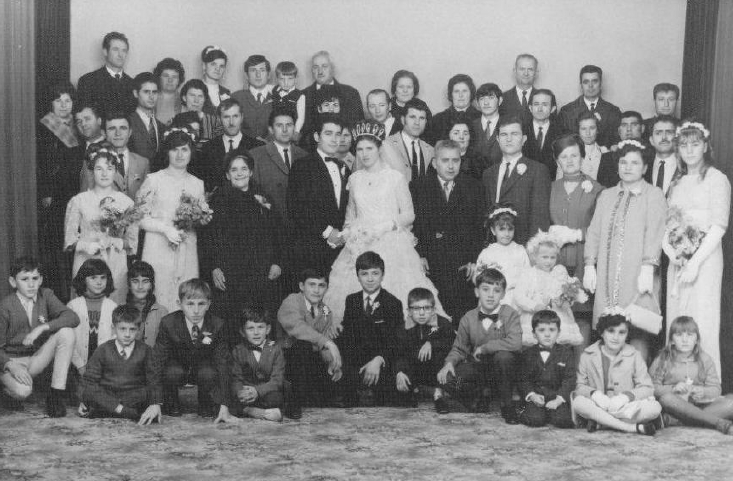
Macedonians’ celebration of weddings and christenings have traditionally
been grand family events. In Melbourne in the 1960s, wedding celebrations
were normally held at home as the extended family was often not present.
When large numbers of Macedonian migrants had arrived in the 1970s,
the St Augustine’s parish church hall in Somerville Road, Yarraville,
became one of the most popular venues used by local Macedonians to hold
wedding receptions. This church hall was also used for christenings,
village dances and community functions. Macedonians commonly referred
to the hall as ‘Polskiot hall’ (literally meaning ‘Polish
hall’, apparently because the manager of the hall was of Polish
nationality).
Village Associations
Macedonian village associations were also formed. Every weekend there
were several village dances held throughout the inner west at venues
that included, in addition to St Augustine’s parish church hall,
the local scout hall in Canterbury Street, Yarraville, the Maltese Club
in Severn Street, Yarraville, the Masonic Hall in Newport, Altona North
High School hall and Paisley High School hall. In Newport, there was
a significant number of Macedonians from the village of Kuratica in
the Ohrid region. The first to arrive was Mile Derusevski, in 1962.
He sponsored four co-villagers to Australia, and, through the process
of chain migration, others followed throughout the 1960s and early 1970s.
Except for a handful of families that settled in Sydney and Wollongong,
the remainder settled in Newport, and, by the end of the 1970s, 35 families
from Kuratica were living there.24 The Kuratica village community was
characterised by its blood ties and was particularly close knit. A village
social association was formed and dances were regularly held at the
scout hall in Market Street, Newport and later at the Masonic Hall,
on the corner of Melbourne Road and Mason Street, Newport.25
Large
Image

Macedonian wedding, Yarraville, 1969. Photograph courtesy of Bob
Spasevski.
Community Picnics
Macedonians left fertile valleys, rich mountain scenery and an agricultural
lifestyle to live and work in the cities and factories of Australia.
Melbourne’s industrialised environment was foreign and, in order
to reconnect to their lives and the landscape they left behind, Macedonians
organised community picnics in garden or bush settings. During the 1950s
and early 1960s, those living in Fitzroy and surrounding suburbs regularly
spent their Sunday afternoons at the Exhibition Gardens, these occasions
are said to have resembled traditional Macedonian village square gatherings.

Masonic Hall Newport. Photograph Nick Anastasovski.
Community picnics came to be an integral part of Macedonian life in
Melbourne generally. A live band would play Macedonian folk music, young
and old would participate in traditional dancing, and copious amounts
of meat and peppers were cooked on barbecues. Kalorama, in the Dandenongs,
became a popular location where Macedonians gathered on an annual basis
and, in 1969, the community purchased a large picnic site at Kinglake.
On the western outskirts of Melbourne, Macedonians from Greek-occupied
Macedonia had been living in Werribee South since the 1920s, where they
engaged in market-gardening businesses. They established an annual Macedonian
community picnic on 25 December at Eastern Beach in Geelong, an event
dating back to the 1940s. When Macedonians under Yugoslav rule arrived
in the late 1960s and 1970s, it seemed natural for them to join with
their Macedonian brothers and sisters.26 At its height during this period,
many thousands of Macedonian families attended the Eastern Beach annual
holiday event—a day when their ethnic and religious sensibilities
would have been even more accentuated than usual, as their Christmas
Day (following the Julian calendar) is on 7 January. Price Reserve,
along the Werribee South foreshore, was also a popular picnic ground
over the summer months for western suburbs village associations during
the latter part of the 1970s. Soccer competitions between villages were
among the events often held at these picnics.
The popularity of picnics is evident from the number of village associations
that purchased their own picnic grounds outside Melbourne (the Bitola
region villages of Mogila purchased a picnic site near Kilmore; Logovardi
purchased a site near Bendigo; and Beranci near Kinglake). In 1984,
Seddon’s Macedonian Orthodox Church, Saint Prophet Elijah (Sveti
Prorok Ilija), purchased a 40-acre picnic ground in picturesque Rocklyn
(Shire of Hepburn). An annual picnic is held there on the first Sunday
after Orthodox Christmas and a monastery, Saint Naum of Ohrid (Sveti
Naum Ohridski), is presently under construction on the site.
Soccer
Recreational time was important to young Macedonian men, who worked
hard during the week in textile factories and meatworks. They regularly
played soccer. Amongst the most popular locations were Beaton Reserve
in Fehon Street, Yarraville, Footscray Park in Footscray, Greenwich
Reserve on The Strand in Newport, and Bond Reserve in Altona North.
Soccer, rather than Australian Rules football, was their game of choice.
Unofficial competitions emerged, whereby Macedonian teams from one neighbourhood
or suburb would challenge a Macedonian team from another neighbourhood
or suburb.27
Owing to the mass of Macedonians settling in the inner western suburbs
in the 1970s, it was inevitable that a second major Macedonian soccer
club in Victoria would be established (the first being Preston Makedonia).
That club is today called Altona Magic but is known to Macedonians as
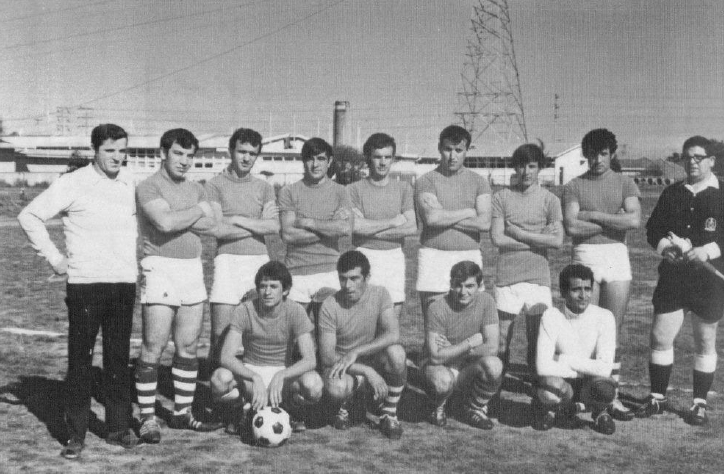
Altona Vardar. Altona Magic has its roots in the late 1960s, when recently
arrived young Macedonian men formed the Kingsville team, then based
in Yarraville. Finding new players was no issue, as each ship that docked
at Port Melbourne brought more soccer players from Macedonia. Club talent
scouts usually knew in advance when to expect the arrival of a Macedonian
migrant with highly regarded soccer abilities. Kingsville scouts waited
at Port Melbourne dock ready to recruit their skilled new players.28
Large
Image

Kingsville Soccer Club, 1968. Photograph courtesy of Altona Magic
football club.
By the mid-1970s, the club had evolved into the Central Altona Social
and Soccer Club (CASSC) and competed in the Victorian Provisional League.
J.T. Gray Reserve in Kororoit Creek Road, Williamstown, served as the
club’s home ground. In 1979, with valuable assistance from the
then Altona City Council, a permanent home for the club was secured
at the newly constructed complex at Paisley Park in Altona North.29
The CASSC would become the principal soccer club for the Macedonian
community in the western suburbs, providing much more than an opportunity
for young Macedonian men to display their football skills. There were
some who participated as club administrators and volunteers, whilst
many others made up the supporters that came each week to watch their
local team play.
Industrial League Soccer
In the early 1970s, the Victorian Soccer Federation (VSF) formed the
Industrial League (IL) soccer competition. Factory workers formed their
own soccer teams and factory management provided team strips and insurance
against injury. Macedonians actively participated in several companysponsored
factory soccer teams in the IL competition, making up almost the entire
team from the Quaker Love factory in West Footscray, and the Aquila
Steel factory in Altona North.30 At the James Miller plastics manufacturing
factory in Altona North, workers formally registered a team in 1974
(through the factory social club) specifically for the purpose of entering
the new IL competition, and Macedonians comprised approximately 95 per
cent of the side that entered IL Division 3. P.J. Grey Reserve in Williamstown
was utilised as the new club’s home ground.31 But, in 1977, the
future of the team was placed in jeopardy when the James Miller factory
relocated its operation away from Altona North. Faced with the prospect
of no longer having a sponsor, the players registered a new soccer club
under the name of Altona Ilinden. In its first year, the club won the
IL championship under its coach, Williamstown resident and meatworker
Peco (Peter) Ilievski. Ilievski had migrated here from Dolno Orizari
village in Macedonia’s Bitola region.32

Altona Ilinden, 1977. Photograph courtesy of Todorka Ilievski.
Although an IL club, Footscray United Vardar (FUV) began as ‘social
soccer’ and did not emerge through a factory-based team. Social
soccer was initiated by young Macedonian men in Footscray Park in the
mid-1970s. In the summer of 1977–1978, a group of players decided
to formalise their social game. They formed their own club and FUV became
part of a recognised competition. The club was registered with the VSF
and commenced playing in IL Division 2 in 1978 wearing red and black.33
The Church of Saint Prophet Elijah
Overwhelmingly of the Orthodox Christian faith, Macedonians have their
own church. Plans began in 1971 to establish the first Macedonian Orthodox
Church in the inner west. However, it was not until 1974 that the former
Methodist church at 83–85 Victoria Street, Seddon, was purchased.
The new church was named Saint Prophet Elijah (Sveti Prohrok Ilija).

Macedonian Orthodox Church, Sveti Prorok Ilija. (Saint Prophet Elijah),
Seddon. Photograph courtesy of Macedonian Orthodox Church.
Macedonians’ involvement in the church went beyond wedding and
christening ceremonies; attendance at Sunday mass and at community services
during Orthodox Easter and Christmas was consistently high (Orthodox
Christian holy days are celebrated according to the Julian calendar;
Easter can be celebrated up to four weeks after western Easter celebrations).
The local council assisted by closing a section of Victoria Street to
traffic on specials days in an effort to manage the large crowds in
attendance.

Young Macedonian men in the Macedonian Orthodox Church Sveti Prorok
Ilija in Seddon, mid-1970s. Photograph courtesy of Goran Kotev.
Language, Films and Folk Dancing
Seddon’s Saint Prophet Elijah church played a leading role in establishing
Macedonians’ sense of belonging, and in organising their social,
cultural and educational life The church confirmed their Macedonian
identity among the many religions and cultures of the inner west. A
church committee managed non-religious activities and financial affairs.
The church complex consisted of a church hall and a number of residential
properties facing Victoria Street, Pilgrim Street and Walter Street.
Some of these properties would later be sold by the church committee.
A residential dwelling on the southern side of the church facing Victoria
Street was transformed into a Macedonian language school (Macedonian
Sunday School).
Preserving and speaking the Macedonian language were seen as being
of great importance. Parents communicated with their children in Macedonian
in the home and expected that their children would be Macedonian speakers.
How else would they communicate with their grandparents in Macedonia?
When the Macedonian language school opened in 1974 it was received with
enthusiasm by the Macedonians community who saw it as a formal continuation
of the language and love of the homeland they had left behind.
Every Saturday more than 100 students, ranging from 6 to 15 years of
age, attended the school to be taught Macedonian language, geography
and history. Teachers came out from Macedonia and instructed the children,
though problems arose when it became clear that political values were
infiltrating the curriculum in support of Tito’s Yugo–communist
regime (which was the reason many families had left for a different
life here).

Site of the Macedonian language school ‘Goce Delchev’.
Photograph courtesy of Macedonian Orthodox Church
The Saint Prophet Elijah church at Seddon organised film nights in
the church hall in the 1970s, screening popular contemporary movies,
such as Krvava Svadba (Blood Wedding), Dolgiot Pat (The Longest Road),
and Crno Seme (Black Seed), brought out from the Republic of Macedonia
and screened to packed houses. Such was the popularity of these film
nights that a larger venue was sought to accommodate community demand.
A new home was found in La Scala Theatre, Footscray, which held approximately
400 people.34
The Ilinden Cultural Association was the first Macedonian folkdancing
group in the western suburbs. Other Macedonian churches in Melbourne
also established their own cultural associations and these were very
popular with the young people. Folk-dancing groups offered the younger
Macedonian generation a sense of belonging and the experience of continuity
of village life. A second folkloric dancing school began in Yarraville
in 1977—the Nikola Karev group.35 The Nikola Karev group was officially
founded on 12 December 1977 and controversially was the first Macedonian
folkloric dance group in Melbourne to be established independently of
the Macedonian Orthodox Church . The Stale Popov dance group was also
formed in the 1970s and operated from a councilowned facility at Langshaw
Reserve in Altona North.

Nikola Karev Folkloric Dance Group, 1977 (Senior group).
Since the Eighties
The final section of this study turns to the changes since the 1980s
and the ongoing questions of Macedonians’ cultural identity more
generally, and more particularly, the place and needs of the now elderly
men and women (many of whom were amongst the first wave of the inner
west’s Macedonians) in a changing world and expanding ‘outer’
inner west community.
In search of new homes on larger blocks of land, large numbers of
the Macedonian community begin moving further westwards in the 1980s:
Altona Meadows, Sunshine, Keilor, St Albans, Sydenham (now named Watergardens),
Delahey and Taylors Lakes. A number of existing cultural and social
groups followed the community to these new areas where people once again
established new lives and institutions. Of note is the Macedonian Orthodox
Cathedral Church, named ‘The Nativity of the Holy Mother of God’,
in Sydenham, erected in support of the large Macedonian community in
the region.
What happened to the elderly when a large segment of the Macedonian
community moved out of the inner west, leaving the aging members of
the community behind? Macedonian communities are generally characterised
by strong family bonds, and elderly parents often actively assist with
the caring of grandchildren. Thus, some elderly Macedonians moved out
to the new areas of settlement to be with their children and grandchildren;
however, many others chose to remain in the familiar surroundings of
the inner west.
After they had retired from the workforce and their children had left
home, many older Macedonians formed groups providing a social outlet
where they could mix with other Macedonians and share common interests.36
The first Macedonian elderly group formed in the western region was
in the inner western suburb of Footscray in 1983.37
Macedonians generally have a high level of home ownership, having come
to Australia with a strong tradition of being self sufficient and a
determination to improve their economic position.38 A 1993 ‘needs
study’ into Macedonian elderly in the western suburbs revealed
that, in a sample group of 100 respondents, 73 per cent owned their
home, 4 per cent had a mortgage on their home, and another 5 per cent
lived in their own home with their children or a relative.39 In response
to the question ‘when you can’t manage on your own what will
happen?’ 52 per cent of respondents were unsure about their future
when they became frail, 28 per cent responded that they would stay at
home with help from family, and 11 per cent stated that they would move
to a Macedonian home for the aged (if one existed).40
Almost 20 years after the study was conducted, a specifically Macedonian
aged-care facility has yet to be established in Melbourne. Those unable
to maintain independent living have become residents in mainstream homes;
however, a lack of English language skills can leave Macedonian residents
feeling isolated and lonely. The need for a their own facility continues
to be
an important priority for the Macedonian community into the 21st century
and one that may be led by the Macedonian Orthodox Church.
In Search of Macedonian Identity
Precisely how many Macedonians resided in the inner west (and in Australia
generally) during the 1970s (prior to the mass movement to newer suburbs
further west in the 1980s) is difficult to determine, given the ambiguity
of statistical data. Prior to 1996, Australian Bureau of Statistics
(ABS) censuses only included ‘country of birth’ data as the
indicator of ethnic identity. As such, Macedonians from the Republic
of Macedonia were categorised as coming from ‘Yugoslavia’
and grouped together with Serbs, Croats and others. Similarly, Macedonians
from Greece appeared on ABS data as Greek migrants—not as ethnic
Macedonians.
Importantly, the 1996 census was the first in which Macedonians living
in Australia were identified statistically as a separate ethnic group.
The Republic of Macedonia, under Yugoslav control from 1944 until 1991,
had only emerged as an independent nation with the end of communism.
Yet, there still remained obstacles to Macedonians being accurately
represented in official statistics. A key problem has been the enduring
legacy of the historical persecution and forced assimilation Macedonians
have been subjected to, in particular by the Greek state since 1913,
which has resulted in some Macedonians being reluctant to publicly acknowledge
their true ethnic identity. Similarly, there were also Macedonians from
the former Yugoslavia who identified as Yugoslav.41 These personal ‘choices’
raise very complex questions beyond the scope of this study but are
nonetheless important to consider in relation to Macedonian migrants
and their children and grandchildren making their lives in Melbourne’s
inner west.
Macedonian community organisations estimate the number of Macedonians
in Australia to be significantly higher than what the official figures
say. Local Government Area (LGA) data from the 1996 census, compiled
on the basis of ‘language spoken at home’, reveal that in
1996 (at this stage significant numbers of Macedonians had left the
inner west), there were 1,431 Macedonian speakers in the City of Hobson’s
Bay (1,273 in 2006), and 1,477 Macedonian speakers in the City of Maribyrnong
(903 in 2006). Unsurprisingly, the number of Macedonian speakers in
the City of Brimbank in 1996 was the highest in the entire western region
of Melbourne, with 6,133 recorded (5,811 in 2006).42 LGA data also reveal
that there has been further movement of ‘Macedonian speakers’
to the outer west municipalities of Wyndham Vale and Melton. The former
has seen a gradual increase in numbers from 715 in 1996 to 953 in 2006,
whilst the latter has seen more substantial growth over the same period,
from 137 in 1996 to 1,400 in 2006.
Conclusion
This article provides a new ethnographic and historical narrative of
the cohort of Macedonians who came from the Republic of Macedonia and
settled in the inner west of Melbourne in the 1960s and 1970s. A unique
feature of this study is that it is largely based on original research
drawing primarily on oral histories. Unlike other more prominent Italian
or Greek communities living in Melbourne, Macedonians were for a considerable
period a relatively obscure ethnic group following their arrival in
the inner west, though this was in contrast to the actual size of the
community. Their visibility was often obscured by the ‘Yugoslav’
label, and this was further reinforced by official government statistics
at that time. However, this article has shown that Macedonians maintained
a strong connection with their homeland and their traditions, and that
Macedonians’ sense of ‘self’ was crucial to their wellbeing.
Importantly, their beleaguered national history meant that preservation
of their national identity was of paramount concern as they established
communities in their new homeland, and they worked hard to keep it alive
and robust in their working lives and in their clubs, churches, cafés,
celebrations, and recreations.
This story has introduced Melbourne’s inner west Macedonians to
a wider readership, and has contributed towards presenting a more visible
and authentic ‘beneath the surface’ account of their recent
history, and their specific and unique place in the region since the
1960s. It has traced their working and cultural lives and involvement
in shaping the inner west of today. In particular, this study documents
for the first time, Macedonians’ statistical and human presence
in the meatworks industry before many of the major abattoirs in the
west’s working-class suburbs closed their doors in the 1980s.
Given the general lack of published material on this subject, it is
envisaged that this study of Macedonians in Melbourne’s inner west
will help, in some measure, to fill that void. By capturing the community’s
formative period during the 1970s and giving greater recognition to
the diverse urban landscape of Melbourne’s inner west, this article
demonstrates how Macedonians, deprived of their autonomy and identity
under different rulers since the late 19th century, made their own valuable
contribution to modern multicultural Australia.
NOTES
1. Most of the interviews were conducted in the second half of 2008
by Nick Anastasovski,the author of this article. Nick was born in the
Macedonian region of Bitola in 1965, and he came to live in Melbourne’s
‘inner west’ as a one year old child in 1966.
2 Peter Hill, The Macedonians in Australia, Carlisle, WA, Hesperian
Press, 1989, p. 12.
3 Hill, p. 12.
4 Hill, p. 20.
5 Jan Harper, ‘The Pecalbars of Gippsland: Macedonian Farm Workers
around Kernot in the 1930s’, Gippsland Heritage Journal, no. 28,
2004, pp. 2–9.
6 There was a small community of Macedonians living in Altona North
from the Lerin region of Greek-ruled Macedonia.
7 Mihailo Kleshtev interview, conducted 17 October 2008. Mihailo was
born in the Bitola region village of Gorno Aglarci and arrived in Australia
in 1964. After forming their own republic through armed struggle in
1944, Macedonians enjoyed a new-found cultural freedom but not the political
freedom they aspired to, for Serbian interests continued to dominate
the new Yugoslavia. There were many dissatisfied elements in the newly
created Yugoslavia, and the Tito regime was eager to suppress any outward
intimation that the experimental new nation was imperfect. To consolidate
the myth, stringent restrictions were placed on leaving. Young Macedonian
men responded to Serbian domination and the economically backward policies
of communist rule by risking their lives and departing illegally over
the border into the neighbouring states from where they sought passage
to western democracies such as Canada, the United States and Australia.
8 Slavka Kalcovska interview, conducted 23 December 2008. Slavka was
born in the Bitola region village of Dihovo and arrived in Australia
in 1960. 9 Kleshtev interview.
10 Zivko Vasilevski interview, conducted 5 June 2008. Zivko was born
in the Bitola region village of Vrajnevci and arrived in Australia in
1970.
11 Kleshtev interview.
12 Slavko Talevski interview, conducted 10 September 2008. Slavko was
born in the Bitola region village of Novaci and arrived in Australia
in 1969.
13 Hobsons Bay Heritage Study, Volume 1b, Thematic Environmental History,
October 2003, p. 20.
14 Wally Curran interview, conducted 30 July 2010. Wally Curran is
the former state secretary of the Australasian Meat Industry Employees
Union (Victoria) 1973–1997.
15 Dobre Ilievski interview, conducted 8 September 2008. Dobre was
born in the Bitola region village of Dolno Orizari and arrived in Australia
in 1971.
16 Ilievski interview.
17 Vasilevski interview.
18 Ilievski interview.
19 Ilievski interview.
20 Curran interview.
21 Curran interview.
22 Curran interview.
23 Blagoja Nikolovski interview, conducted 19 November 2008. Blagoja
was born in the Bitola region village of Zhabeni and arrived in Australia
in 1970.
24 Blagoja Koleski interview, conducted 5 December 2008. Blagoja was
born in the Ohrid region village of Kuratica and arrived in Australia
in 1971.
25 Koleski interview.
26 Kleshtev interview.
27 Vasilevski interview.
28 Peco Stojcevski interview, conducted 15 July 2008. Peco Stojcevski
was born in the Bitola region village of Optichari and is a past president
of Altona Vardar Soccer Club.
29 Stojcevski interview.
30 Risto Pilovski interview, conducted 3 December 2008. Risto was born
in the Mariovo district village of Grunishte and arrived in Australia
in 1972.
31 Pilovski interview.
32 Pilovski interview. Risto Pilovski further advised that J.T. Gray
Reserve remained the home ground of Altona Ilinden for several years
until council moved the club to an alternative venue at Blackshaws Road,
Altona North. However, a lack of acceptable sporting facilities (no
change rooms or training lights) at the new ground saw the team utilise
a truck belonging to player Vele Matovski as the team change room on
match days! Following protests to council over the conditions they were
forced to play under, the club was soon given Bond Reserve in Chambers
Road Altona North as its permanent home ground.
33 Petre Ilioski interview, conducted 25 November 2008. Petre was born
in the Ohrid region village of Openica and arrived in Melbourne in 1970.
34 Kleshtev interview. See also Makedonski Zhivot (newspaper), August
1974, p. 8.
35 Violeta Risteska interview, conducted 20 June 2008. Violeta Risteska
(Trifunovska) joined the Nikola Karev group in 1977 upon its establishment
and remained an active member until the early 1980s.
36 Macedonians in Victoria: Community Profile, p. 66.
37 Macedonian Background Notes, Footscray Migrant Resource Centre Inc.,
prepared by Spase Velanovski, October 1991, p. 4.
38 Macedonian Community Welfare Association of the Western Region Inc.,
‘The Macedonian Elderly: A Needs Study of the Macedonian Elderly
in the Western Region of Melbourne’, in Victor Bivell (ed.), Macedonian
Agenda: Sixteen Essays on the Development of Macedonian Culture in Australia,
Five Dock, NSW, Pollitecon Publications, 1995, pp. 74–112.
39 Bivell (ed.), p. 95.
40 Bivell (ed.), p. 105.
41 Macedonians in Victoria: Community Profile, Melbourne, Macedonian
Welfare Workers’ Network of Victoria, undated, p. 26.
42 Statistical data relating to Macedonian speakers has been sourced
from the respective local government websites.
This article was first published in Victorian Historical Journal
Vol. 82, No. 1, June 2011
Source: www.pollitecon.com